Rooftop rainwater harvesting: how much water your home can really save
A simple rule of thumb shows how many litres your roof can collect each monsoon. Here is how storage and recharge systems work, and what to check before you build one.
Here is a number worth remembering: one millimetre of rain falling on one square metre of roof gives you one litre of water. Multiply that across a full monsoon and an ordinary Indian rooftop turns out to be a surprisingly large catchment.
Doing the maths. Take a flat roof of 100 square metres in a city that receives around 800 millimetres of rain a year. In theory, that roof receives 80,000 litres. Some water is lost to evaporation, splashing and the first dirty flush, so engineers apply a runoff factor. Even after those losses, a home could capture tens of thousands of litres, enough to make a real difference to a household that buys tanker water in summer.
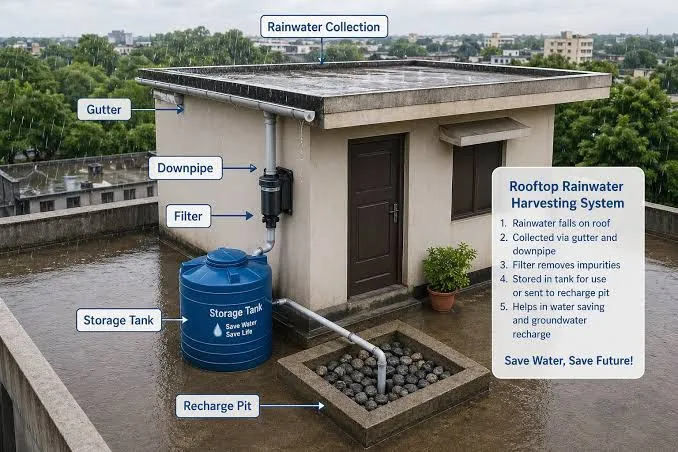
Two ways to use the water. A harvesting system can store rainwater or send it underground. Storage means routing roof water through a simple filter of sand, gravel and charcoal into a tank or sump for washing, gardening or, after proper treatment, wider household use. Recharge means directing water into a pit, trench or unused borewell so it seeps into the ground and replenishes the aquifer below.
Many homes combine the two. Storage gives immediate benefit, while recharge helps the whole neighbourhood, because groundwater is a shared resource. Tamil Nadu made rainwater harvesting compulsory for buildings in the early 2000s, and several cities have since written it into their building rules.
Before you build
- Check your roof surface; clean concrete or tiles work best.
- Install a first-flush device to discard the initial, dirtier runoff.
- Clean gutters and filters before each monsoon.
- Keep tanks covered to prevent mosquito breeding.
- Ask your municipal body about local rules, designs and any incentives.
Why it matters
Groundwater supplies a large share of India's drinking water and irrigation, and in many districts the water table has fallen sharply as pumping outpaces recharge. Paved cities make it worse, because rain runs into drains instead of soaking in. Individual roofs cannot fix the problem alone, but when a whole colony harvests, borewells often recover.
The investment is modest compared to a lifetime of water bills, and the system works every time it rains. The next monsoon is always the best time to start.